Joint Attention and ABA: Building a Key Social Skill
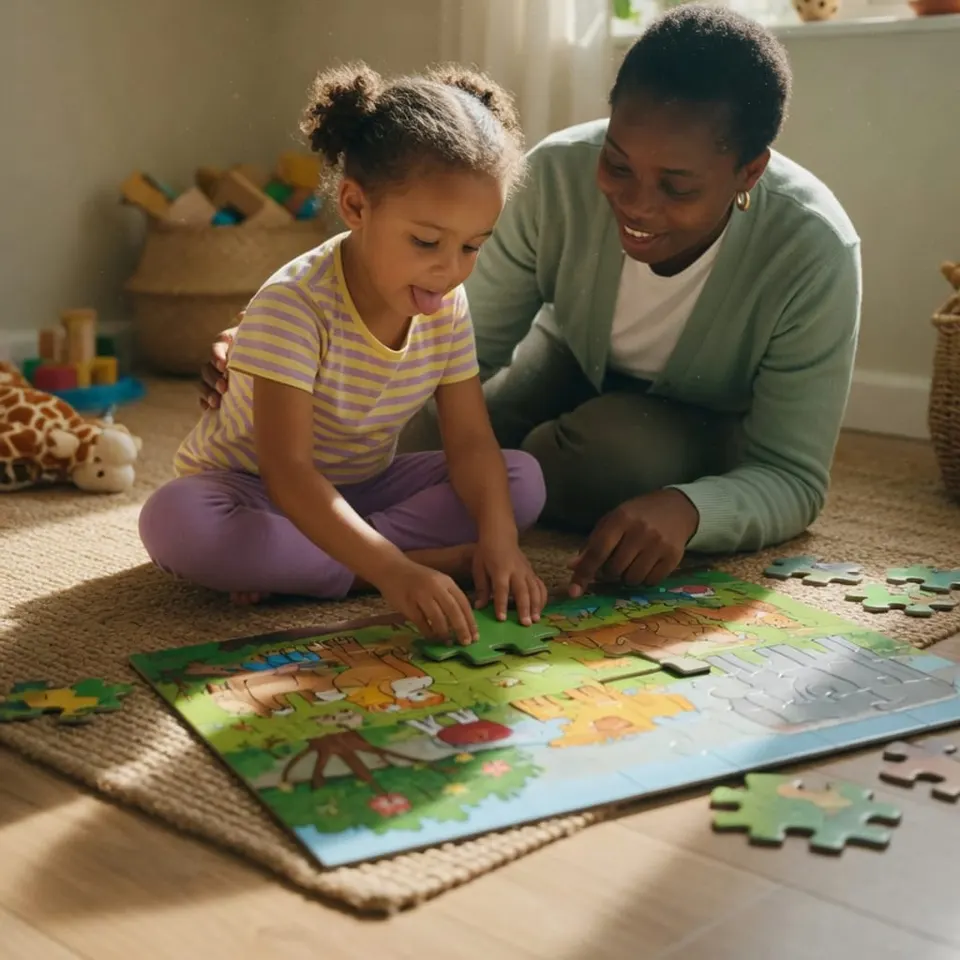
In short: Joint attention is the shared focus of two individuals on an object or event. It is critical for language, social, and cognitive development. ABA therapy breaks down this skill into teachable steps, using positive reinforcement to build it naturally. Our free service matches families with vetted BCBA-led providers who can design personalized programs to target joint attention.
Key takeaways
- Joint attention is a foundational social skill that typically emerges around 9-12 months of age.
- Deficits in joint attention are common in autism and can affect language, social, and cognitive development.
- ABA therapy uses systematic methods (e.g., discrete trial training, natural environment teaching) to teach joint attention.
- Early intervention focusing on joint attention can improve long-term outcomes for children with autism.
What Is Joint Attention?
Joint attention is the ability to share a common focus on an object, event, or activity with another person. It involves three elements: you, your child, and a third item-such as a toy, a picture, or a passing bird. For example, when your child points to a plane in the sky and then looks at you to share the moment, that's joint attention. This skill is often described as the "meeting of minds" and forms the bedrock of social communication.
🔗 Related reading: Does Private Insurance Cover ABA in California? · Autism Therapy Near Me
Why Joint Attention Matters for Development
Joint attention is not just a cute milestone; it is a building block for many later abilities. Children who develop strong joint attention often go on to show better language skills, more complex play, and stronger social relationships. It is linked to empathy, theory of mind (understanding others' perspectives), and academic readiness. For children with autism, delays in joint attention can be one of the earliest red flags, which is why it is a core target in many early intervention programs.
The Link to Language and Communication
Before children speak their first words, they learn the power of shared focus. Joint attention teaches that words and gestures have meaning because they refer to something both people are looking at. Research shows that the frequency of joint attention behaviors at 12 months predicts vocabulary size at 24 months. When a child cannot easily share attention, they miss countless opportunities to learn labels, social cues, and conversational rhythms.
Social and Emotional Foundations
Joint attention also helps children understand that others have intentions and emotions. By looking back and forth between an interesting object and a parent's face, a child learns to "check in" emotionally. This shared experience builds trust and connection. Later, it supports turn-taking, following a gaze, and interpreting facial expressions-all essential for friendships.
How Joint Attention Develops Typically
In typical development, joint attention emerges around 9 months and becomes more sophisticated over the second year. Early signs include following a parent's point, showing objects to share interest, and looking between a toy and a parent's eyes. By 18 months, children often use pointing to direct attention. Understanding this typical timeline helps families recognize when a child might need extra support.

🔗 Related reading: Free & Low-Cost Autism Services in Georgia · Autism Therapy Near Me
Joint Attention in Autism
Many autistic children show differences in joint attention from an early age. They may not respond when someone points, or they might rarely point to share interest. They may look at an object but not look back at a person to share the experience. This is not a lack of interest, but a difference in how the brain processes social information. Because joint attention is a gateway to learning, addressing it early can have a cascade of benefits. Applied behavior analysis (ABA) is one evidence-based approach that systematically builds this skill.
How ABA Builds Joint Attention
ABA therapy breaks complex skills into small, teachable steps and uses positive reinforcement to encourage desired behaviors. Joint attention is taught through carefully planned interactions that feel natural and fun. A Board Certified Behavior Analyst (BCBA) designs the program based on your child's unique strengths and needs.
Discrete Trial Training (DTT)
In DTT, a therapist might present an interesting toy and prompt the child to look at the toy and then at the therapist. Each successful response is reinforced with praise or a preferred item. Over time, the prompts are faded, and the child learns to initiate joint attention spontaneously. DTT provides clear, repeated opportunities to practice the skill in a structured setting.
Natural Environment Teaching (NET)
NET takes advantage of everyday situations. During play, the therapist might pause and look expectantly at a wind-up toy, waiting for the child to make eye contact before activating it. Or the therapist might blow a bubble and then look at the child, encouraging them to look back and forth. These interactions look like play but are carefully designed to teach joint attention in a motivating context.
Pivotal Response Training (PRT)
PRT focuses on "pivotal" areas like motivation and self-initiation. For joint attention, the therapist might follow the child's lead, join in with an interesting action, and then wait for the child to reference them. Keeping the child motivated and giving them choice increases their desire to share attention. PRT often leads to more generalized skill use across settings.

What to Expect in ABA Sessions for Joint Attention
Your child's ABA sessions might include both table-based activities and floor play. The therapist will collect data on each attempt at joint attention-such as the number of times the child looks between a toy and a person, or the child's latency to respond to a point. Goals will be individualized, starting with simpler steps (e.g., following a point to a nearby object) and moving to more complex ones (e.g., pointing to share an interesting event). Sessions are typically one-on-one and happen in home, clinic, or school settings. Progress is tracked carefully so the BCBA can adjust the teaching strategies.
Practical Tips for Parents and Caregivers
You can support joint attention at home without turning everyday life into a therapy session. Here are a few evidence-informed strategies:
- Follow your child's interest. If they are fascinated by a spinning toy, join them and add a comment or sound. This creates a shared moment.
- Use animated facial expressions and sounds. Exaggerated "oohs" and "aahs" draw attention to your face and invite your child to look at you.
- Pause and wait. After an interesting event (like a toy crashing), stop and look at your child with an expectant expression. This gives them a chance to initiate a look or gesture.
- Imitate your child. If they bang a drum, bang a drum too, then pause. They may look at you to see if you'll do it again.
- Use books with flaps or pop-ups. These create natural moments of shared surprise when you both see something new.
Common Mistakes to Avoid
Even with good intentions, some approaches can be counterproductive. Avoid forcing eye contact by holding your child's face. That can feel overwhelming and aversive. Also, avoid asking "What do you see?" over and over-this can feel like a test. Instead, model enjoyment by saying "Wow, look at that!" while looking both at the object and at your child. Finally, don't compare your child's joint attention to a sibling's or a friend's. Each child develops at their own pace, and progress in ABA is measured against their own baseline.
Costs and Insurance Coverage for ABA Therapy
ABA therapy is widely covered by private insurance due to state mandates and the Affordable Care Act. Most plans include some level of coverage for autism-related services. Medicaid also covers ABA in many states. Out-of-pocket costs depend on your plan's deductible and co-pay. Our free matching service, Apply for ABA, can help you find BCBA-led providers who accept your insurance, including many who accept Medicaid. We do not charge families for this service-we simply connect you with vetted providers in your area.
Getting Started with ABA for Joint Attention
If you think your child might benefit from ABA to improve joint attention skills, the first step is a diagnostic evaluation or a referral from your pediatrician. Then you can contact providers. But with so many options, it can be hard to know where to start. That's where we come in. Apply for ABA is a free service that matches families with vetted, BCBA-led providers. You fill out a short form with your preferences, and we connect you with providers who have availability and take your insurance. This saves you hours of research and phone calls. Many families report seeing progress in joint attention within weeks of starting well-designed ABA therapy. Let us help you find the right team to support your child's development.